
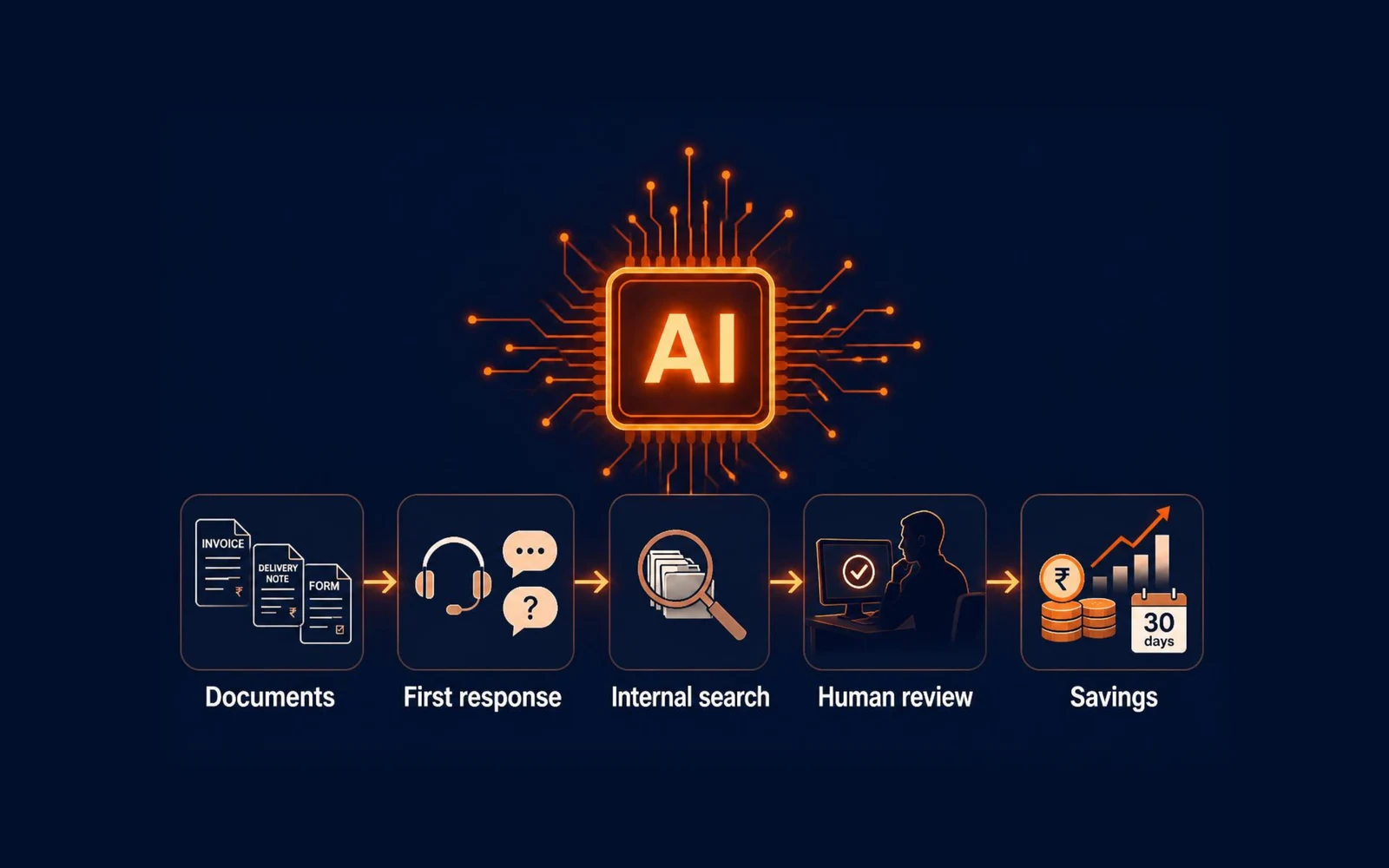
Most companies have now had the meeting.
Someone asks what our AI plan is. Somebody mentions a competitor who has launched something. A few tools get named. Everyone agrees it is important, the meeting ends, and nothing specific happens until the next one.
The difficulty is not enthusiasm. It is that AI is usually discussed as a capability rather than as a purchase, and a capability is impossible to evaluate.
So here is a more practical framing, built from projects we have actually delivered: which work in your business is worth handing to a machine, what that decision costs after the pilot, and how to tell within a month whether it is working.
- Automate work that is frequent, rule-bound, cheap to get wrong and backed by data you control.
- Documents, first response and internal search are where AI pays most reliably.
- Budget for data cleanup, a human review loop and ongoing maintenance, not just the model.
- Prove one measured process in thirty days before expanding to the next.
A four-question filter
Before automating anything, run the task through four questions. If it fails any one of them, it is the wrong place to start.
1. Does it happen often enough to matter?
A task that runs forty times a day is worth automating. A task that runs twice a month is not, no matter how annoying it is. Count the frequency before you estimate the saving. Most disappointing AI projects fail this first question and were approved anyway.
2. Are the rules stable?
Automation works when the same inputs lead to the same decisions. If your process depends on unwritten judgement that changes with the client, the season, or who is on duty, AI will produce confident answers that are quietly wrong.
3. What happens when it is wrong?
Every automated step will be wrong sometimes. The question is what that costs.
A misfiled support ticket is a minor irritation. A wrong invoice sent to a client is a phone call. A wrong dosage, payment, or compliance record is something else entirely.
Automate freely where errors are cheap and visible. Keep people in the loop where errors are expensive or silent.
4. Do you own the data it needs?
If the information lives in three systems, half of it in a spreadsheet on someone's laptop, the first cost of your AI project is not the model. It is getting that data into one reliable place.
This is the question that usually decides the real timeline.
Three places it reliably pays
Across the work we see, three categories deliver returns consistently rather than occasionally.
- Document handling. Invoices, purchase orders, delivery notes, forms, scanned paperwork. High volume, stable structure, and errors that are immediately visible. This is the least glamorous category and the most dependable one.
- First response and routing. Not replacing your support team, but reading what comes in, classifying it, pulling the relevant history, and putting it in front of the right person with a draft. The human still answers. They simply start from minute three instead of minute zero.
- Internal search and reporting. Every growing company reaches a point where the answer exists somewhere but nobody can find it. Making internal knowledge answerable, and making recurring reports generate themselves, returns hours that never appear on any invoice but are paid for every week.
Three costs nobody budgets for
This is the part that rarely appears in AI articles, and it is the part that decides whether a project succeeds.
- The cleanup. Before intelligence, consistency. Duplicate customers, inconsistent naming, missing fields, three definitions of the same metric. In most projects this is the largest single piece of work, and it is entirely unglamorous.
- The review loop. For the first weeks, a person has to check the output. That review is real work and has to be staffed. Skip it and you will discover the failure modes from a client instead of from your own team.
- The maintenance. Your processes change. Your formats change. The models change underneath you, sometimes without notice. An automation is not a purchase, it is a small system that needs an owner. Decide who that is before you launch, not after something breaks.
None of these are reasons to avoid AI. They are reasons to budget honestly, so the second phase is funded rather than abandoned.
How to prove it in thirty days
You do not need a strategy. You need one measured result.
Agree the exit criteria in week one, while everyone is still objective.
Where people stay
Keep humans wherever the consequence of being wrong is larger than the cost of the review.
Financial approvals. Anything a client sees with your name on it. Unusual cases that fall outside the rule you wrote down. Any decision a regulator might ask you to explain.
The strongest systems are not the most automated ones. They are the ones where the machine handles the volume and a person owns the outcome.
What good looks like a year later
Nobody talks about the AI. That is the sign.
The reports arrive on their own. Support answers faster than it used to and no customer has noticed why. The month-end close takes two days instead of five. New staff find answers without asking three colleagues.
The technology has become infrastructure, which is where useful technology always ends up.
In short
AI is worth the money when it is pointed at work that is frequent, rule-bound, cheap to get wrong, and backed by data you actually control. It is expensive when it is pointed at whatever looked impressive in a demonstration.
Start with one measured process. Fund the cleanup and the review loop honestly. Expand only when the numbers say so.
Done that way, this stops being a technology decision and becomes what it always should have been: an operational one.
Questions people ask
How do we know if a process is worth automating?
Run it through four checks: frequency, stable rules, cost of being wrong, and whether you control the data. A process that fails any one of them is the wrong place to begin, however appealing it looks.
What is the real cost of an AI project?
The model is rarely the expensive part. Data cleanup, the human review loop during the first weeks, and ongoing maintenance usually account for most of the effort. Budget for all three or the project stalls after the pilot.
How long before we see a result?
A single well-chosen process can be measured within thirty days, provided you record a baseline before you start. Projects without a baseline tend to be argued about rather than evaluated.
Will AI replace our team?
In most small and mid-sized businesses it does not. It absorbs repetitive volume so the same team can handle more work without growing headcount, while people keep the decisions that carry consequences.
Do we need to fix our data first?
Usually, at least partly. Inconsistent records, duplicates and scattered systems limit what any intelligent system can do. The data work is not optional; it is the part that determines whether the rest works.
Originally published in The Build Brief, our newsletter on LinkedIn. Read the original edition.

 GUIDEThe Build Brief
 SEO
SEO MARKETING